


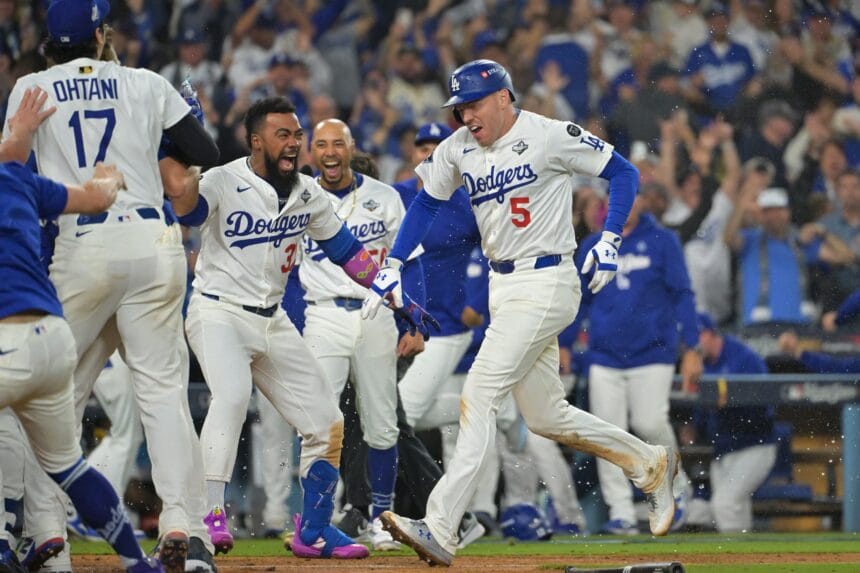
The Los Angeles Dodgers claimed a dramatic 6–5 victory over the Toronto Blue Jays in an 18-inning World Series epic on Monday night at Dodger Stadium. This game stretched deep into the night and matched the longest postseason contest by innings in major league history. Entering Game 3, sportsbooks had positioned the Dodgers as moderate home favorites, with betting lines hovering around -145 for Los Angeles and +125 for Toronto. Those odds reflected home-field advantage and a rested pitching staff, though neither team could have anticipated the historic endurance test that unfolded.
Freddie Freeman ended the seven-hour marathon by launching a full-count sinker from Brendon Little over the center-field wall to open the bottom of the 18th inning. The home run was Freeman’s second walk-off blast in as many years, following the game-ending grand slam he hit in last season’s World Series opener. His latest decisive swing capped an evening of relentless tension, emotional swings, and extraordinary performances on both sides.
Shohei Ohtani contributed significantly, belting two solo home runs and collecting two doubles through the first seven innings. He became only the second player in World Series history to tally four extra-base hits in a single game. Once the Blue Jays began issuing intentional walks, he reached base safely nine times, the most in a postseason game in more than eight decades.
The Dodgers jumped ahead early with home runs from Teoscar Hernández in the second inning and Ohtani in the third. Toronto countered with a four-run fourth inning, two of those runs unearned following a fielding error by Tommy Edman. Alejandro Kirk delivered the big blow with a three-run homer off starter Tyler Glasnow, giving Toronto a 4–2 lead. Andrés Giménez widened the margin with a sacrifice fly.
Los Angeles answered in the fifth. Kiké Hernández singled to lead off, later scoring on a deep Ohtani double. Freeman followed with a run-scoring single down the right-field line to tie the game at 4–4. From there, both teams traded threats but not runs until the seventh, when Bo Bichette lined a ball into right field that deflected along the wall, allowing Vladimir Guerrero Jr. to score from first for a 5–4 Toronto lead.
Ohtani then tied the game in the bottom of the inning with his second home run, setting up a stalemate that persisted for nearly two hours of baseball. The Dodgers’ bullpen delivered a herculean performance, throwing scoreless inning after scoreless inning. Rookie Roki Sasaki induced crucial groundouts in the eighth and stranded runners again in the ninth. Clayton Kershaw, appearing in extra innings for the first time in his nineteen-year career, escaped a bases-loaded jam in the twelfth.
Toronto held its own on the mound, with relievers repeatedly preventing the Dodgers from capitalizing on long fly balls that died on the warning track as the evening temperatures cooled. Max Scherzer, the veteran right-hander, started Game 3 for Toronto, becoming the first pitcher to appear in the World Series with four different franchises.
As the game wore on, players and fans dug in. An 89-year-old Sandy Koufax remained in his seat for the duration, while the crowd of more than fifty-two thousand stood through many of the late innings. Guerrero, who paced the dugout, even took breaks by snacking on an apple between tense at-bats.
The defining performance came from Will Klein, the final available Dodgers reliever. Klein threw four shutout innings and a remarkable seventy-two pitches, more than twice his previous career high. His effort kept the Dodgers’ hopes alive long enough for Freeman to deliver the game-winner.
By the time the contest ended at nearly midnight on the West Coast, more than six hundred pitches had been thrown by a combined nineteen pitchers. The Dodgers’ victory gave them a 2–1 advantage in the best-of-seven series and maintained their opportunity to clinch the championship at home for the first time since 1963.
The Blue Jays, despite the loss, emphasized that the series remained far from over. Manager John Schneider noted that the team had “lost a game, not the World Series,” a sentiment echoed by Guerrero. As the teams prepared for Game 4, the Blue Jays were scheduled to send right-hander Shane Bieber to the mound opposite Ohtani, who had dominated his previous postseason start.
After one of the longest and most dramatic games in World Series history, both teams turned their attention to the next chapter of a series defined by resilience and razor-thin margins.